Dr. Carolle Method™ Certified Organization Program
Community Workers Training
Who This Training Is For
- Immigrant and refugee families facing fear, deportation, and family separation
- Community members experiencing acute trauma, grief, or psychological collapse
- Crises that arise at 2 AM with no professional backup available
- The emotional weight of witnessing suffering day after day without adequate tools or support
- Burnout from absorbing the pain of entire communities while maintaining composure and continuing to show up
Beyond the Work – The Whole Person
What no other community worker training addresses:
What Your Staff Will Learn and Experience
DCIAM™ – Dr. Carolle's Instant Anti-Distress Method
A three-breath parasympathetic activation technique grounded in Traditional Chinese Medicine (TC) with dual application – for the community worker’s own regulation and for guiding people in the community through acute distress. Simple enough to use in any setting – a living room, a church basement, a parking lot, or a community meeting – powerful enough to shift a nervous system in under three minutes.
Community workers use DCIAM™ for themselves:
- Before entering a home or crisis – for centering
- Between emotionally demanding field encounters – for reset
- After exposure to acute distress, violence, or community trauma – for release
- At the end of a long day in the field – for emotional restoration
- At home, when the weight of the day follows them through the door
Community workers also learn how to guide DCIAM™ with the people they serve – so individuals and groups can use it independently for ongoing emotional regulation, crisis stabilization, and daily resilience.
DCSRT™ – Dr. Carolle's Self-Reset Technique
A self-administered technique using precise acupressure points – providing immediate mental clarity and nervous system reset in 30 seconds, privately, anywhere, without anyone noticing.
Used by community workers for:
- Mental fatigue after sustained field work
- Emotional overload between community encounters
- The moment before walking into a crisis
- Decision fatigue and cognitive exhaustion after long field days
- Any moment at home when everything feels like too much
METRT™ – Murat Emotional Trauma Release Technique (Optional)
Optional individual 2–3 minute hands-on trauma release sessions for community workers requesting personal restoration. Performed exclusively by Dr. Carolle – never taught as a self-administered technique.
METRT™ addresses the accumulated secondary trauma community workers carry from years of frontline service, including:
- Witnessing family separation, deportation, and community violence
- Repeated exposure to acute trauma without professional debriefing or support
- The moral injury of having too little to offer in situations that require so much
- The grief of working in communities under sustained political and systemic threat
- The personal weight they carry from their own lives outside of their community work
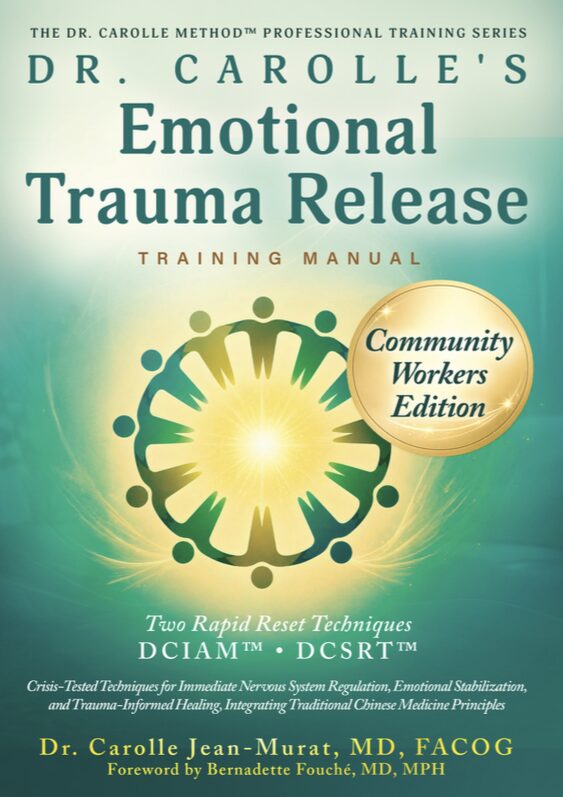
Every participant receives Dr. Carolle's Community Workers Emotional Trauma-Release Training Manual
Training Format
Duration: 4-hour intensive workshop
Capacity: 20-30 staff per session, scalable by organization size
Location: Your facility – any community meeting space
Language: English, Spanish, and Haitian Kreyòl
Manual: Included for every participant
Session Structure Includes
- Personal experience of all techniques – every participant practices, not just observes
- Hands-on guided practice with Dr. Carolle’s direct instruction
- Community-specific integration guidance – how to use these techniques in homes, community meetings, crises, and group settings
- Optional individual METRT™ sessions during breaks for staff requesting personal restoration
- Each participant receives the Community Workers Emotional Trauma-Release Training Manual
Flexible Scheduling Options
- Single organization-wide training
- Staff and volunteer cohorts
- Multi-organization community health training day
- County or government agency workforce development
- Emergency crisis response training following a community tragedy
Why This Works – Crisis-Tested Over Two Decades
2008 – Hurricane Katrina
2010 – Haiti Earthquake
2012 – San Diego Mesa College
December 2024 – Multi-City Crisis Tour
March 2026 – Wicomico County, Maryland
Ongoing – AKESNA Sisters, Haiti
What Makes This Different
Dr. Carolle Jean-Murat is a board-certified physician (MD, FACOG) with over 40 years of medical experience. She developed these techniques after experiencing severe professional burnout herself – understanding from the inside what it means to give beyond capacity without the tools to recover.
She serves as co-administrator of Hôpital St. Joseph in Haiti, where she has led medical and crisis response teams under extreme conditions for over 25 years.
These methods are:
- Neurobiologically grounded – based on Traditional Chinese Medicine acupressure principles and modern nervous system science, not a wellness concept
- Physician-developed – created by a board-certified MD, not a wellness coach or corporate trainer
- Crisis-tested – refined in earthquake zones, disaster settings, and sustained community crises, not in a classroom
- Language-accessible – works across language barriers; the nervous system responds to breath, rhythm, and presence
- Immediately applicable – community workers use what they learn during their very next field encounter, the same day
- Whole-person – addressing not just professional resilience but the complete human being who shows up to serve
Dual Benefit
Community Worker Wellbeing
- Immediate tools to prevent and interrupt burnout
- Nervous system regulation under sustained crisis conditions
- Private reset available anywhere, anytime, in any field setting
- Reduced compassion fatigue and vicarious trauma
- Increased resilience and long-term sustainability in the work
- Balance between the demands of the work and the demands of their own lives
Enhanced Support for the Community
- Immediate, practical interventions for individuals and groups in acute distress
- Tools that work across language barriers and cultural contexts
- Skills the community can carry and teach to others
- Reduced escalation in community crises
- A trained workforce that protects itself and the people it serves